
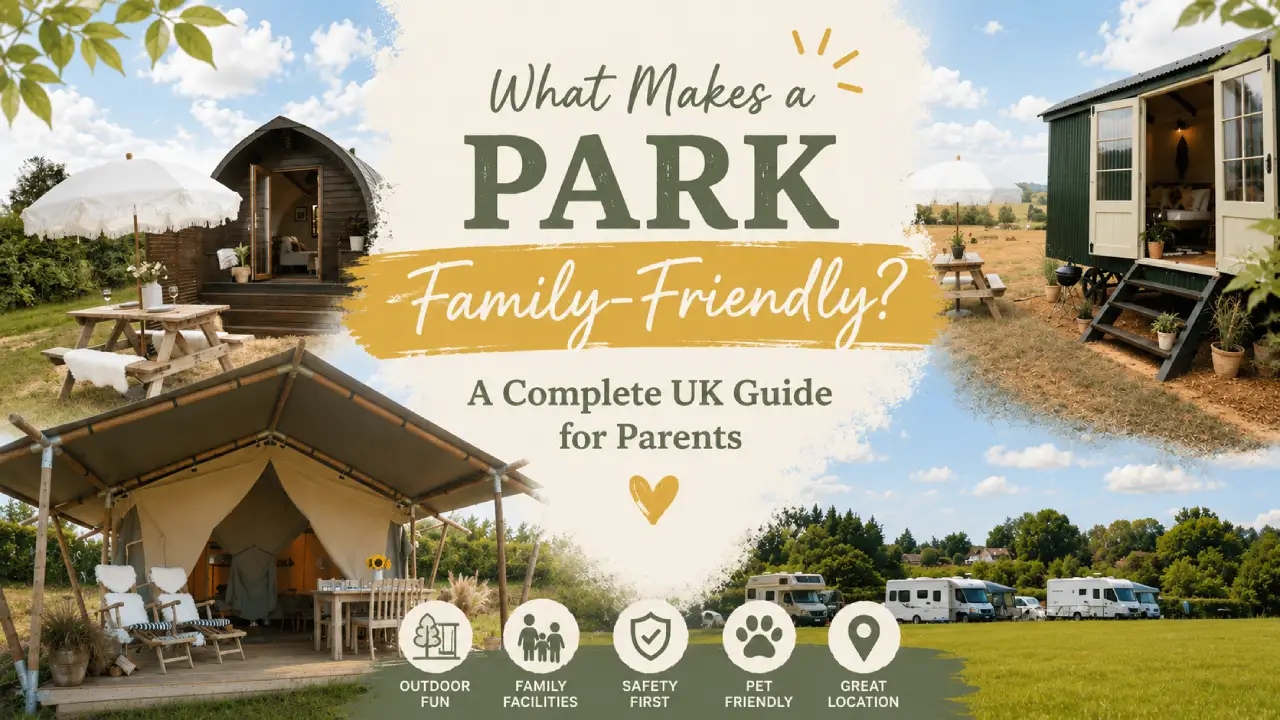
Quick Answer: A family-friendly park is one designed around the safety, comfort and entertainment of children alongside the practical needs of the adults travelling with them. In the UK, the term applies to country parks, holiday parks and caravan parks that meet five core criteria: secure surroundings, child-appropriate facilities, varied accommodation, age-suitable activities, and an accessible, well-maintained setting. The best family-friendly parks are independently rated by bodies such as the AA, VisitEngland or the British Holiday & Home Parks Association (BH&HPA).
If you have ever spent twenty minutes scrolling through best family holiday parks UK listicles and come away no clearer on what family-friendly actually means, you are not alone. Every holiday park in the country claims the label. Very few define it. This guide does — and gives you a 15-point checklist you can run any park through before you book.
We’ve written it from the perspective of running Meadow View Country Park, a 52-acre family park in Wimborne, Dorset, but the framework applies to any UK park you’re considering. By the end you’ll know exactly what to look for, what to avoid, and which questions to ask.
What Is a Family-Friendly Park?
A family-friendly park is an outdoor leisure or holiday destination typically a country park, holiday park, or caravan park that has been deliberately designed, equipped and operated to suit families with children. That deliberate design is what separates a genuinely family-friendly park from one that simply allows children to attend.
In practice, a family-friendly park combines three things at once: physical safety (secure boundaries, supervised facilities, well-lit walkways), practical convenience (cots, highchairs, family bathrooms, baby-changing, on-site food), and meaningful entertainment that suits the ages of the children staying.
Family-Friendly Park vs Holiday Park vs Country Park: The Difference
These three terms are often used interchangeably online, which is part of why parents end up confused. Here’s how they actually differ:
| Type | What It Is | Family-Friendly by Default? |
|---|---|---|
| Country park | A protected countryside area with public access, usually featuring walking trails, picnic areas and nature features. Often council-managed or privately run on rural land. | Usually yes, but facilities vary widely. |
| Holiday park | A commercial site offering accommodation (caravans, lodges, glamping) and on-site facilities for short stays. | Most market themselves this way, but quality varies enormously. |
| Caravan park | A site primarily for touring caravans, motorhomes and tents. May or may not offer accommodation. | Some are; many are designed for couples or retirees. |
The strongest family parks tend to be hybrids — country parks that also offer overnight accommodation, like Meadow View, so children get genuine countryside (not a tarmac estate of identical caravans) alongside the practical comforts a family needs.
The 5 Pillars of a Family-Friendly Park
After looking at every accreditation framework in the UK leisure industry — AA Pennant ratings, VisitEngland’s Quality Assured Camping, BH&HPA standards, the David Bellamy Conservation Award — and combining them with what parents actually ask us at reception, we’ve distilled it down to five pillars. If a park meets all five, it is genuinely family-friendly. If it misses any, ask why before you book.
Safety
The non-negotiable foundation. A family-friendly park has clearly defined boundaries (whether physical fencing or natural boundaries like hedgerows), well-lit walkways for evening movement between accommodation and amenity blocks, supervised reception or arrival systems, and procedures for medical incidents (a defibrillator on site, first-aid trained staff, and posted emergency numbers).
For families with very young children, additional features matter: traffic-calmed roads inside the park, low-speed zones near play areas, and pitches positioned away from any water features that aren’t fenced.
Space
Space is one of the most undervalued aspects of a family-friendly park. Tight pitches and narrow gaps between caravans create stress for parents managing small children. Genuine family-friendly parks give you elbow room — typically 5–8 metres between pitches, large grass areas, and shared open ground children can roam without straying off-site.
Acreage matters here. A 50-acre park with 200 pitches feels completely different from a 5-acre park with 200 pitches, even if both are technically family-friendly. Meadow View sits at 52 acres of meadow and woodland — the kind of footprint that gives kids room to run.
Stay-Type Variety
A genuinely family-friendly park offers more than one type of accommodation, because families themselves come in radically different shapes. A young couple with a baby needs different facilities from a multi-generational group of nine. The strongest parks give you the choice between glamping, static caravans, lodges, touring pitches and tent pitches — so you can match the stay to your stage of life and your budget.
If you’re weighing up which type works best for your family, our comparison of glamping pods versus static caravans breaks down the practical differences in detail.
Stuff to Do
A family-friendly park needs to give children something to do that isn’t a screen. The best parks layer activities by age: play areas and petting animals for under-8s, outdoor adventure and freedom-to-roam for 8–14s, and voluntarily put the phone down activities for teenagers — stargazing nights, outdoor cinema, fire-pit cooking, late-evening walks.
Our stables and petting area is built around exactly this principle: a draw for younger children, but one that older kids quietly enjoy too.
Surroundings
A park’s surroundings shape the entire holiday. A family-friendly park doesn’t just need good on-site facilities — it needs to sit somewhere that gives families a reason to leave the park each day. Proximity to beaches, woodland, National Trust properties, family attractions and child-friendly pubs matters as much as the on-site offer.
In Dorset, the strongest family-park locations sit within a 30-minute drive of the Jurassic Coast, the New Forest National Park, and Bournemouth’s beaches — geographic stacking that’s hard to replicate elsewhere in southern England.
How to Score a Park: The 15-Point Family-Friendly Checklist
Run any park through these 15 questions before you book. A genuinely family-friendly park should score 13 or above. If it scores below 10, look elsewhere.
- Is the park gated or has clearly defined boundaries?
Look for: physical security or natural perimeter. - Are walkways well-lit at night?
Look for: solar or mains lighting between accommodation and amenity blocks. - Does it hold an AA Pennant rating, VisitEngland Quality Rose, or BH&HPA membership?
Look for: at least one third-party accreditation. - What is the minimum space between pitches?
Look for: 5 metres or more. - What’s the total acreage relative to pitch count?
Look for: at least 0.2 acres per pitch. - Is there more than one accommodation type available?
Look for: glamping, static, touring and tent options where possible. - Are there dedicated family bathrooms with baby-changing?
Look for: a private, lockable family unit, not a shared block. - Are cots, highchairs and travel cots available to hire or borrow?
Look for: clearly listed in the FAQ or on the booking page. - Is there a play area appropriate to the ages staying?
Look for: age-banding signage and modern equipment. - Are there genuinely engaging activities for children aged 8 and above?
Look for: animal experiences, outdoor cinema, fire pits, stargazing, organised events. - Is the park dog-friendly with clear rules?
Look for: published dog policy, on-lead areas, dog-walking field. - Is there on-site food, or is the nearest pub within walking distance?
Look for: at least one of the two. - Are pushchairs and wheelchairs catered for across the site?
Look for: hard or gravel paths, level access, accessible bathrooms. - Are pricing and inclusions transparent before booking?
Look for: no surprise charges for parking, electric hook-up or arrival/departure. - Does the park sit within easy reach of family-friendly day-trip destinations?
Look for: beaches, National Trust sites, attractions within 30 minutes.
What “Family-Friendly” Means at Each Age Stage
The honest truth is that family-friendly looks completely different depending on the age of your children. A park that’s perfect for a toddler can be tedious for a 14-year-old, and vice versa. Here’s how to read the label by life stage.
0–2 Years (Babies and Toddlers)
At this stage, family-friendly means: traffic-free zones, family bathrooms with baby-changing, blackout-suitable accommodation for nap time, and accommodation you can heat properly. Glamping bell tents and static caravans both work well — tent camping is harder unless the weather is reliable.
What matters most: are cots and travel cots provided, is the accommodation warm and dry, and is the family bathroom close to your pitch.
3–6 Years (Pre-school and Early Primary)
This is the “running around” age. Family-friendly means safe open space, a play area scaled to small children, animals to look at or feed, and short walks that won’t end in a meltdown. Petting areas, pizza nights and outdoor cinema all come into their own here.
7–10 Years (Primary)
The let me explore age. Family-friendly now means controlled freedom — enough space for children to walk to the loos or the play area independently, but still within a secure park. Activities that involve doing rather than watching matter most: pony grooming, fossil hunting on nearby beaches, building dens.
11–14 Years (Tweens)
The trickiest age, and the one most family-friendly parks fail. By 11, children want some independence and they want activities that aren’t aimed at little kids. Family-friendly here means: free Wi-Fi where they can text friends, decent food options, evening activities (stargazing, outdoor cinema), and the social mix of other tweens on-site.
If you’re trying to plan a stay that genuinely works for this age group, our birthday celebration ideas post covers what works for older children and groups.
15–18 Years (Teenagers)
The honest assessment: most teenagers don’t want a holiday park holiday. The ones that work for this age are the ones offering things teens would voluntarily put their phone down for — fire-pit cooking with friends, late-night stargazing walks, hot-tub access in the evening, and freedom to socialise without parents hovering.
Our glamping at night post explores what evenings can look like for older children and teens at a country park.
Multi-Generational Stays
If you’re travelling with grandparents and grandchildren, family-friendly needs to mean different things at once. Practically, that means: level access for older guests with mobility concerns, accommodation large enough for three generations (typically a luxury static caravan or a cluster of nearby bell tents), and activities that work intergenerationally — petting animals, walks, watching films together outdoors.
Safety Standards You Should Look For
This is the section most guides skip, and it’s the one we get asked about most often at reception. UK holiday parks aren’t required to display their accreditations prominently, so you usually have to ask.
UK Accreditation Bodies Explained
| Body | What It Means |
|---|---|
| The AA (Automobile Association) | Awards 1–5 “Pennants” based on facilities, cleanliness, environmental management and customer service. A 4 or 5-Pennant park is operating to a high standard. |
| VisitEngland Quality Assured Camping & Caravan Park | National tourism body’s accreditation scheme covering similar criteria to the AA, awarded annually. |
| British Holiday & Home Parks Association (BH&HPA) | The UK trade body for holiday parks. Membership signals adherence to industry standards on consumer protection, safeguarding and park operation. |
| David Bellamy Conservation Award | Voluntary eco-accreditation. Gold-level awards indicate genuine commitment to wildlife and environmental management. |
| The Camping and Caravanning Club / The Caravan and Motorhome Club | Membership-based accreditation networks that inspect affiliated sites. |
On-Site Safety Features Checklist
When you arrive, the visible safety markers to look for are: a defibrillator on display in or near reception, posted emergency contact details, clear fire procedures for each accommodation type, low-speed traffic signage, fenced or supervised play areas, and visible CCTV in shared spaces. If any of those are missing, ask why.
For specific safety queries about Meadow View, our FAQs page covers the most common questions, and you can contact us directly with anything not answered there.
Essential Facilities at a Family-Friendly Park
The facilities that matter depend on who’s travelling, but the universal markers below apply to virtually every family.
For Babies and Toddlers
The honest priorities here are: family bathrooms with baby-changing units and family-sized showers, cot and travel cot availability (usually on request call ahead), highchair availability at any on-site food venue, kettle and microwave access for sterilising and bottle warming, and accommodation you can darken sufficiently for daytime naps.
Luxury static caravans handle this stage particularly well because they’re properly insulated, heated, and have everything you’d have at home compressed into one tidy unit.
For Older Children
For 5–14s, what makes a real difference is: a proper play area that isn’t an afterthought, animals or wildlife on or near site (our stables and petting area is the most popular feature with this age group), open space that’s safe enough to allow some independent roaming, and on-site food the kids will actually eat — pizza tends to win.
For Parents
The parent-facing facilities that quietly make or break a family holiday: reliable Wi-Fi (genuinely free, not paywalled per device), proper coffee on-site, somewhere to sit outside that isn’t the pitch you’re sleeping on, and ideally a bar or food venue where adults can have a drink after the children are settled.
Accommodation Choices for Families
Choosing accommodation is where most family-park bookings go right or wrong. Here’s the honest breakdown.
Glamping (Bell Tents, Shepherd Huts, Safari Tents, Pods)
Glamping gives you the romance of canvas without the practical pain of pitching it yourself. For families, the strongest options are 6-metre bell tents (sleep 5), safari tents and larger glamping pods — all of which give children a sense of “proper” outdoor adventure with proper beds and weatherproof comfort.
Glamping suits families who want the outdoor experience but don’t want to commit to a full canvas-tent holiday. It works year-round in well-insulated units with wood-burning stoves, but check the heating arrangements before booking a winter glamping stay.
Static Caravans and Lodges
Static caravans are the most practical option for families with babies or for multi-generational groups. You get proper bedrooms, a kitchen, central heating, a bathroom, and enough space to spread out — essentially a holiday cottage on a country-park site.
The trade-off: less of the “we went camping” feeling. The advantage: you’ll all sleep better and the holiday is logistically simpler.
Touring Caravans, Motorhomes and Tent Pitches
If you own your own touring caravan, motorhome or tent, the question becomes whether the park’s touring and motorhome pitches suit your unit and your family. Look for: hardstanding or grass options, electric hook-up availability, water and waste points, and proximity to the family amenity block.
For families considering switching from tents to motorhomes, our piece on hiring versus owning a motorhome walks through the cost and lifestyle trade-offs.
Activities That Make a Park Genuinely Family-Friendly
Activities are where holiday parks separate themselves from glorified accommodation. The strongest family parks layer their offering across three categories.
Outdoor and Nature Activities
These tend to be the highest-value activities because they cost very little to provide and produce the strongest memories. Look for: nature trails, fossil hunts (if the park is near the Jurassic Coast), bird-spotting walks, river or lake access (with appropriate safety), and den-building areas.
Animal Encounters and Petting
Few things rank higher with younger children than feeding or grooming an animal. A park with even a small petting area or stables will out-deliver one without. At Meadow View, our stables and petting area has become the single most-photographed part of the park.
Stargazing and Evening Activities
This is the category most parks miss. A genuine family-friendly park does evenings as well as days. Look for: outdoor cinema, fire pits, stargazing nights, late-evening hot-tub access, and organised seasonal events.
Meadow View sits on the edge of the Cranborne Chase International Dark Sky Reserve, one of only a handful of dark-sky areas in southern England — meaning stargazing genuinely works here, not as a marketing line but as a measurable fact. Our glamping at night post covers what evenings actually look like.
For families planning around specific dates, check our What’s On page for seasonal events, or read our coverage of nearby community events like Family Fest Wimborne 2026.
Accessibility and Inclusion at Family Parks
Most family-park guides skip this section entirely, which is part of why families with specific accessibility needs find planning so hard. Here’s what to look for.
Mobility and Pushchair Access
A genuinely accessible family park has: hardstanding or gravel paths (not just grass) between accommodation and amenity blocks, level access into at least some accommodation types (typically static caravans and ground-floor lodges), accessible family bathrooms with grab rails, and parking close to accommodation.
If you’re travelling with a pushchair or a wheelchair user, ask the park specifically about path surfaces and gradient before booking. Photos alone don’t always reveal this.
Sensory and Neurodiverse-Friendly Features
For families with autistic children or sensory-sensitive children, the right park can make the difference between a relaxing holiday and a difficult week. Helpful features include: quieter pitches away from main thoroughfares, accommodation in canvas (which softens sound) or static caravans (which control noise from outside), low-stimulation play areas, and staff briefed on what a “quieter” pitch request means.
This is rarely advertised, but most family parks including ours will accommodate specific sensory requests if you mention them when booking. Get in touch via our contact page and tell us what would help.
Inclusive Practices to Look For
Look for: published accessibility statements, hire of basic mobility equipment, willingness to take specific requirements at booking, accessible information formats on the website, and staff who answer accessibility questions directly rather than deflecting.
Practical Considerations
A handful of practical factors that often decide whether a park works for your family.
Dogs and Pets
A family-friendly park that’s also dog-friendly is genuinely useful — most UK families now travel with dogs, and a park that excludes them effectively excludes those families. Look for: clear dog rules (number per pitch, on-lead policies, restricted breeds), a dog-walking field or off-lead area, and at least one dog-friendly food venue on or near site.
Year-Round vs Seasonal Parks
A park that’s open year-round signals investment in winter-grade infrastructure: heating, insulation, all-weather paths, year-round staff. Seasonal-only parks aren’t worse, but they tend to suit fair-weather camping rather than family stays in shoulder seasons.
Rainy Day Resilience
The single best test of a family park is what it offers when it rains. Look for: covered outdoor seating, indoor play options or partner attractions, kitchens you can actually cook in, and accommodation big enough for a family of four to spend a wet afternoon in without falling out.
Family-Friendly Parks in Dorset and the South Coast
Dorset has emerged as one of the strongest family-park regions in the UK, and there’s a specific geographic reason: it stacks four major family-holiday assets within a small area.
The Jurassic Coast (a UNESCO World Heritage Site) runs along the southern edge, offering fossil hunting, dramatic coastal walks and family beaches at Lulworth Cove, Durdle Door and Studland. The New Forest National Park sits to the east, with free-roaming ponies and 219 square miles of accessible woodland. Bournemouth, Poole and Sandbanks deliver classic seaside days within thirty minutes’ drive of most central Dorset parks. And Cranborne Chase National Landscape — newly redesignated from AONB status — sits to the north, offering dark skies, rolling chalk downland and rural calm.
Meadow View sits centrally in this geography, in the village of Horton near Wimborne, fifteen minutes from Bournemouth and twenty minutes from the New Forest. For a fuller view of how the location works for visiting families, see our piece on glamping near Bournemouth.
How Much Does a Family-Friendly Park Holiday Cost in the UK?
Family-park holidays are typically cheaper than equivalent hotel or cottage stays, but the cost varies significantly by accommodation type, season, and what’s included. Here’s a realistic 2026 picture for a family of four staying three nights in the UK.
| Accommodation Type | Low Season | High Season (School Holidays) |
|---|---|---|
| Tent pitch (own tent) | £45–£90 total | £90–£180 total |
| Touring caravan / motorhome pitch | £60–£120 total | £120–£240 total |
| Glamping bell tent (furnished) | £180–£300 total | £300–£600 total |
| Static caravan / lodge | £200–£400 total | £400–£900 total |
How to Save Money on a Family Park Holiday
Three honest tactics that work: book midweek rather than weekends (typically 30–40% cheaper), travel in shoulder seasons (May, June, September) when the weather still holds and prices are reasonable, and book direct with the park rather than through aggregators — direct bookings usually skip commission costs and unlock loyalty offers.
Our Summer School Holidays in Dorset 2026 guide goes into the cost-saving angle in more detail.
Frequently Asked Questions
What makes a park family-friendly?
A family-friendly park combines secure surroundings, child-appropriate facilities (cots, highchairs, family bathrooms, baby-changing), varied accommodation suited to different family sizes, age-appropriate activities, and accessibility for pushchairs and wheelchairs. The strongest are independently accredited by the AA, VisitEngland or BH&HPA.
What’s the difference between a holiday park and a country park?
A holiday park is a commercial site primarily offering accommodation for short stays. A country park is a protected countryside area with public access, sometimes also offering accommodation. The best family destinations are hybrids — country parks that also offer overnight stays.
Are holiday parks safe for toddlers?
Family-friendly holiday parks designed for young children are generally very safe, often more so than urban hotel stays. Look for traffic-calmed pitches, fenced play areas, family bathrooms, and parks rated by the AA or VisitEngland. Toddler-specific features like cot hire and baby-changing should be explicitly listed.
Is glamping suitable for families with babies?
Yes, provided the glamping unit is properly heated, weatherproof and large enough. Furnished bell tents and shepherd huts with wood-burning stoves work well from spring to autumn. For year-round stays with very young babies, a static caravan tends to be more practical.
Do family-friendly parks accept dogs?
Most do, but rules vary widely. Look for parks that publish clear dog policies — number permitted per pitch, on-lead rules, dog-walking areas, restricted breeds. Some accommodation types may be designated non-pet.
What facilities should a family-friendly park have?
At minimum: family bathrooms with baby-changing, on-site play areas, cot and highchair availability, family-sized accommodation, clear safety procedures, accessible paths, and on-site or nearby food. The strongest parks add petting animals, outdoor cinema, fire pits and seasonal events.
Are family-friendly parks open all year round?
Some are, some aren’t. Year-round parks tend to be better equipped for shoulder-season stays because they invest in heating, insulation and all-weather paths. Seasonal-only parks usually run from March or April to October.
How much does a family-friendly park holiday cost in the UK?
For a family of four staying three nights, expect to pay £45–£180 for a tent pitch, £120–£240 for a touring caravan pitch, £180–£600 for furnished glamping, and £200–£900 for a static caravan or lodge depending on the season.
Can grandparents stay at a family-friendly park?
Absolutely. The strongest parks accommodate multi-generational stays through larger accommodation types like luxury static caravans, accessible paths, and activities that work intergenerationally — petting animals, walks, outdoor cinema and shared meals.
Are there family-friendly parks near the Jurassic Coast?
Yes — Dorset has one of the strongest concentrations of family-friendly parks in the UK, largely because of its proximity to the Jurassic Coast, the New Forest, Bournemouth beaches, and Cranborne Chase National Landscape.
Ready to Plan Your Stay?
If you’ve worked through the 15-point checklist and you’re ready to look at specific options, our glamping, off-grid camping and luxury static caravan pages cover each accommodation type in detail. For dates, prices and availability, check our booking page, or get in touch directly if you have specific accessibility, dietary or family-composition questions you’d like to discuss before booking.
A family-friendly park, done properly, isn’t really about the swimming pool or the kids’ club. It’s about giving your family a few days of genuine outdoor calm, with enough comfort that everyone sleeps and enough activity that nobody is bored. That balance is what we’ve built Meadow View around — and it’s what the 15-point checklist is designed to help you find, wherever you end up staying.