
Quick answer: Roof tent camping for beginners becomes much easier when you check the campsite rules before booking. Confirm that roof tents are accepted, which pitch category to choose, whether the surface is grass or hardstanding, how much space your open setup needs, whether your vehicle can remain on the pitch, and whether you need electric hook-up. You should also check rules for awnings, facilities, arrival times and weather conditions before paying for your stay.
Roof tent camping gives you the freedom of camping without having to sleep directly on the ground, but booking your first campsite can be slightly confusing.
Should you choose a tent pitch or a touring pitch? Can a roof tent go on grass? Do you need electric hook-up? How large does the pitch need to be once the tent, ladder and awning are open?
There is no single answer that applies to every campsite. Different UK sites classify roof tents in different ways. For example, some campsites treat them as touring units while others place them on campervan or specifically designated roof tent pitches.
The safest approach is to understand your full setup and check the individual campsite requirements before booking.
This guide explains the main things first time roof tent campers should look for when choosing a pitch, along with what you can expect if you are planning a roof tent camping break in Dorset.
What Is Different About Booking a Pitch for a Roof Tent?
The main difference between a roof tent and an ordinary ground tent is that your vehicle forms part of your accommodation.
With a traditional tent, you can normally pitch your tent and move the car somewhere else. With a roof tent, your sleeping area remains attached to your car, van or other suitable vehicle.
That means your booking needs to take account of more than the dimensions of the vehicle itself.
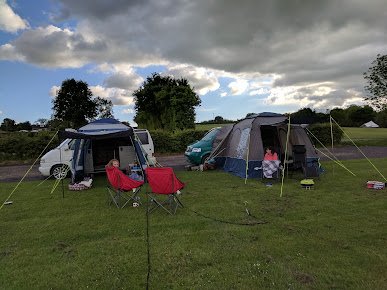
Once opened, your setup may also include the roof tent extending beyond the side or rear of the vehicle, a ladder, an awning or annex, chairs, a table and other camping equipment.
You therefore need a pitch that allows your vehicle to remain in the correct position and gives enough room for the complete setup.
This is why checking pitch size and vehicle access matters more for roof tent camping than many beginners initially expect.
Do Campsites Allow Roof Tents?
Many UK campsites welcome roof tents, but you should never assume that every pitch is suitable.
Some campsites restrict cars from camping fields. Others have particular grass, hardstanding, campervan or touring pitches that must be selected when booking.
There is also no universal booking category.
One campsite may ask you to book your roof tent as a touring unit, while another may require a campervan pitch. Some campsites have their own roof tent category.
The Caravan and Motorhome Club, for example, asks roof tent users to select its Touring option. The National Trust notes that roof tents are accepted at many of its campsites but may need to use campervan pitches because vehicles are restricted from some tent areas.
Before paying, look for a roof tent option in the booking system. If it is not clear, contact the campsite and tell them exactly what type of vehicle and roof tent setup you have.
12 Things to Check Before Booking Your First Roof Tent Pitch
1. Confirm That Roof Tents Are Accepted
Start with the most basic question.
Does the campsite accept roof tents?
A site accepting ordinary tents does not automatically mean cars with roof tents can use the same camping area. Some tent fields keep vehicles away from pitches, which obviously will not work when your tent is attached to your vehicle.
Look for roof tents within the accommodation or pitch descriptions. If they are not specifically mentioned, ask before booking.
It is much easier to clarify this in advance than to discover on arrival that your selected pitch cannot accommodate your setup.
2. Ask Which Pitch Type You Should Book
Do not guess whether you should choose a tent, campervan, touring or motorhome pitch.
Booking classifications vary between campsites.
Tell the campsite you are arriving in a car or other vehicle with a roof mounted tent and ask which category should be selected.
This also helps prevent you from paying for facilities you do not need or choosing a pitch that does not allow your vehicle to remain beside your accommodation.
3. Check Whether the Pitch Is Grass or Hardstanding
Roof tents can be used on different pitch surfaces, but each option has practical considerations.
A grass pitch gives you a traditional camping environment and can make it easier to position awning pegs, guy lines or an annex if your setup includes them.
Hardstanding can provide a firm surface for the vehicle, particularly during wet conditions, but you should check how any ladder, awning or annex is expected to be positioned.
Neither surface is automatically better for every roof tent.
Your ideal choice depends on the design of your tent, the equipment you are bringing and the campsite rules.
4. Check the Full Pitch Size
One of the most common mistakes is thinking only about the size of the car.
Measure your complete setup.
That means considering the vehicle, the roof tent when fully opened, the ladder, any annex or awning and the area you want for chairs or other equipment.
Some roof tents open sideways and can significantly increase the width of your setup. Others extend from the rear.
Check the manufacturer’s open dimensions before travelling and compare them with the campsite’s stated pitch size.
If the campsite does not provide dimensions, ask whether your complete setup will fit comfortably within the allocated area.
5. Make Sure Your Vehicle Can Remain on the Pitch
This point is fundamental to roof tent camping.
Your car cannot normally be moved to a separate car park after setting up because the roof tent remains attached to it.
When looking at a campsite, check whether vehicles are allowed to stay on the pitch overnight.
If parking is normally separate from the tent field, ask whether different arrangements apply to roof tent campers.
You should also make sure there is suitable vehicle access all the way to the pitch.
6. Think About Leaving the Campsite During Your Stay
With a standard tent, you can leave your accommodation standing while taking the car out for the day.
Roof tent camping works differently.
If you want to drive to Wimborne, the beach, a local attraction or somewhere for lunch, you will normally need to pack the roof tent away first.
For a one or two night stay this might not bother you at all. For a longer trip with several planned day trips, it is worth considering how quickly your particular roof tent can be packed down and set up again.
It is one of the practical differences beginners often overlook when planning their first trip.
7. Decide Whether You Actually Need Electric Hook-Up
Having a roof tent does not automatically mean you need an electric pitch.
The important question is what equipment you want to power during your stay.
If you mainly need lights and occasional phone charging, portable lighting and a suitable power bank may be enough for a short trip.
If you want to use additional powered camping equipment, your requirements may be different.
Think about your actual electricity needs before booking rather than assuming electric hook-up is essential.
If you deliberately want a simpler camping experience, a non-electric pitch can work particularly well with a roof tent.
8. Check Rules for Awnings, Annexes and Gazebos
The roof tent itself may fit easily, but extra equipment can considerably increase the size of your pitch.
If you are bringing an awning, roof tent annex, gazebo or pup tent, check whether it is permitted and whether it is included in your booking.
The entire setup will normally need to stay within the boundaries of your allocated pitch.
Measure everything together rather than treating each item separately.
This is particularly important when booking online because the campsite may allocate your pitch according to the accommodation information you provide.
9. Check the Campsite Facilities
Your sleeping setup might be raised above the ground, but you still need all the usual campsite facilities.
Before booking your first roof tent trip, check what is available on site.
Pay particular attention to toilets, showers, drinking water, washing-up facilities and waste disposal.
If you are choosing a non-electric pitch, also think about how you will handle lighting and charging during your stay.
The right campsite for a beginner is not necessarily the one with the longest facilities list. It is the one that provides the facilities you actually need while still offering the style of camping you want.
10. Check Arrival Times and Aim to Set Up in Daylight
A roof tent may be quick to open once you are familiar with it, but your first setup is rarely the best time to test how everything works in the dark.
Check the campsite arrival window before travelling and, where possible, arrive with enough daylight to position your vehicle and open the tent without rushing.
You will have time to check that the vehicle is sitting comfortably, position the ladder correctly and organise the rest of your pitch before the evening.
If you expect to arrive late, contact the campsite in advance to understand its late arrival procedure.
11. Read the Site Rules Before You Travel
Individual campsites have their own rules covering vehicles, pitch boundaries, fires, barbecues, dogs, quiet hours and additional camping equipment.
Do not rely on the rules from a campsite you visited previously.
Pay particular attention to anything affecting your vehicle and the footprint of your roof tent setup.
Knowing the rules beforehand makes arrival easier and reduces the chance that you will have to reposition equipment after setting everything up.
12. Check the Weather and Pitch Conditions
Roof tents are designed for outdoor use, but weather still matters.
Check the forecast before your journey, particularly if strong winds or persistent rain are expected.
Follow the guidance provided by your roof tent manufacturer rather than assuming every model has the same weather limits.
Pitch conditions are important too. If heavy rain has affected a grass campsite, vehicle access and ground conditions can change.
When poor weather is forecast, contacting the campsite before setting off can give you a clearer idea of current pitch conditions.
Grass vs Hardstanding vs Electric: Which Pitch Is Right for a Roof Tent?
There is no single pitch type that is best for every roof tent.
| Pitch type | Why campers choose it | What to check |
|---|---|---|
| Non-electric grass | Simple camping experience with no hook-up required | Ground conditions, vehicle access and your own power needs |
| Electric grass | Traditional grass pitch with access to power | EHU requirements, cable rules and additional cost |
| Hardstanding | Firm surface for the vehicle | Space for the ladder, awning, annex and pegged equipment |
| Dedicated roof tent pitch | Specifically allocated for vehicle based camping | Individual dimensions, surface and included facilities |
For beginners, suitability matters more than whether a particular pitch sounds more luxurious.
Choose a pitch that fits your complete setup and the way you intend to camp.
How Much Space Does a Roof Tent Pitch Need?
There is no universal pitch size that suits every roof tent.
A compact two person model on a small vehicle can have very different space requirements from a larger family roof tent with an annex.
Before booking, find the open dimensions of your tent and measure the entire camping footprint.
Include your vehicle length and width, the tent when open, the ladder, any annex or awning and other equipment that needs to remain beside the vehicle.
You can then compare that measurement with the pitch dimensions supplied by the campsite.
If there is any doubt, contact the site. Giving them the dimensions of your complete setup is far more useful than simply saying that you have a roof tent.
What Beginners Often Forget About Roof Tent Camping
The most noticeable difference is that your bedroom travels with your car.
If you want to drive somewhere, the roof tent normally needs to be closed first.
It also helps to think carefully about what you take into the tent overnight. Repeatedly climbing down the ladder because your torch, phone cable or jacket is still in the car gets old quickly.
Parking position matters too. A reasonably level vehicle generally makes the sleeping setup more comfortable, so do not rush to open the tent the moment you reach the pitch.
Wet weather also changes the routine. Packing a damp roof tent away before driving somewhere is different from leaving a wet ground tent standing at your campsite.
None of these issues makes roof tent camping difficult. They simply become easier when you know about them before your first trip.
Roof Tent Camping at Meadow View Country Park in Dorset
For campers looking for roof tent camping near Wimborne, Meadow View Country Park welcomes roof tents on its off-grid camping pitches in the Dorset countryside.
The pitches are non-electric grass pitches providing up to 8 × 14 metres of space. The standard pitch price includes parking for one car, four guests and up to two dogs. Roof tents, pup tents, awnings and gazebos are permitted provided everything remains within the designated pitch area. Guests are also sent their pitch number and map in advance of their booking.
This makes it possible to plan the dimensions of your setup before you arrive rather than trying to work everything out once the roof tent is already open.
Meadow View is located on Horton Road in Wigbeth, near Wimborne and Three Legged Cross in Dorset. The countryside location also provides a base for visitors exploring the New Forest and the South Coast.
If this is your first experience of camping without electric hook-up, it is worth reading Meadow View’s first time off-grid camping guide as well. It covers what a non-electric stay feels like, what to expect when you arrive and how the pitches are organised.
For information about the pitches themselves, the off-grid camping pitches in Dorset page should be your next step before checking availability.
A 60-Second Roof Tent Pitch Booking Checklist
Before pressing the booking button, run through these questions.
| Check | What you need to confirm |
|---|---|
| Roof tents | Does the campsite accept them? |
| Booking category | Should you select tent, touring, campervan or roof tent? |
| Surface | Is the pitch grass or hardstanding? |
| Pitch size | Will your full open setup fit? |
| Vehicle | Can it remain on the pitch overnight? |
| Site access | Can you drive directly to your allocated pitch? |
| Electricity | Do you genuinely need electric hook-up? |
| Awning or annex | Is additional equipment permitted? |
| Facilities | Are toilets, showers and water available? |
| Arrival | What is the check-in time and late arrival procedure? |
| Site rules | Are there restrictions affecting your setup? |
| Weather | Are conditions suitable for your tent and pitch? |
A few minutes spent checking these details can prevent most of the problems first time roof tent campers encounter when booking a campsite.
Frequently Asked Questions About Roof Tent Camping
Do campsites allow roof tents?
Many UK campsites accept roof tents, but policies vary. Some campsites allocate specific touring, campervan or roof tent pitches because vehicles cannot enter their ordinary tent fields. Always check the individual site’s rules before booking.
Do I book a roof tent as a tent or campervan?
It depends on the campsite. There is no universal UK booking category for roof tents. Some sites classify them as touring units, others use campervan pitches, and some offer dedicated roof tent options. Follow the individual campsite’s booking instructions.
Can a roof tent go on a grass pitch?
Yes, many roof tent campers use grass pitches, provided vehicles are permitted and the ground conditions are suitable. You should also check that the pitch provides enough room for the vehicle, open tent, ladder and any awning or annex.
Do roof tents need electric hook-up?
No. A roof tent does not itself require electric hook-up. Whether you need an electric pitch depends on the equipment you want to power during your stay.
How big a pitch do I need for a roof tent?
The required size depends on your vehicle and roof tent. Measure your vehicle plus the tent when fully open, ladder, annex or awning and other equipment. Compare the total footprint with the campsite’s pitch dimensions before booking.
Can I drive away after setting up a roof tent?
You normally need to close and secure the roof tent before driving the vehicle. If you expect to make several day trips during your stay, factor the pack-down and setup time into your plans.
Can I bring a roof tent to Meadow View Country Park?
Yes. Meadow View Country Park accepts roof tents on its non-electric grass camping pitches near Wimborne in Dorset. Pitches offer up to 8 × 14 metres of space, with one car, four guests and up to two dogs included in the standard pitch price.
Ready for Your First Roof Tent Camping Trip?
Your first roof tent camping trip does not need to be complicated.
The most important step is choosing a campsite and pitch that suit your complete setup rather than simply finding somewhere that allows tents.
Check how the site classifies roof tents, measure your setup while fully open, understand the pitch surface and facilities, and make sure your vehicle can remain where you sleep.
If you are looking for roof tent camping near Wimborne, Meadow View Country Park offers spacious non electric grass pitches in the Dorset countryside, with roof tents welcomed as part of the site’s off-grid camping options.
Once you know the dimensions of your setup and the dates you want to travel, check the off-grid camping pitch information and availability before booking.