
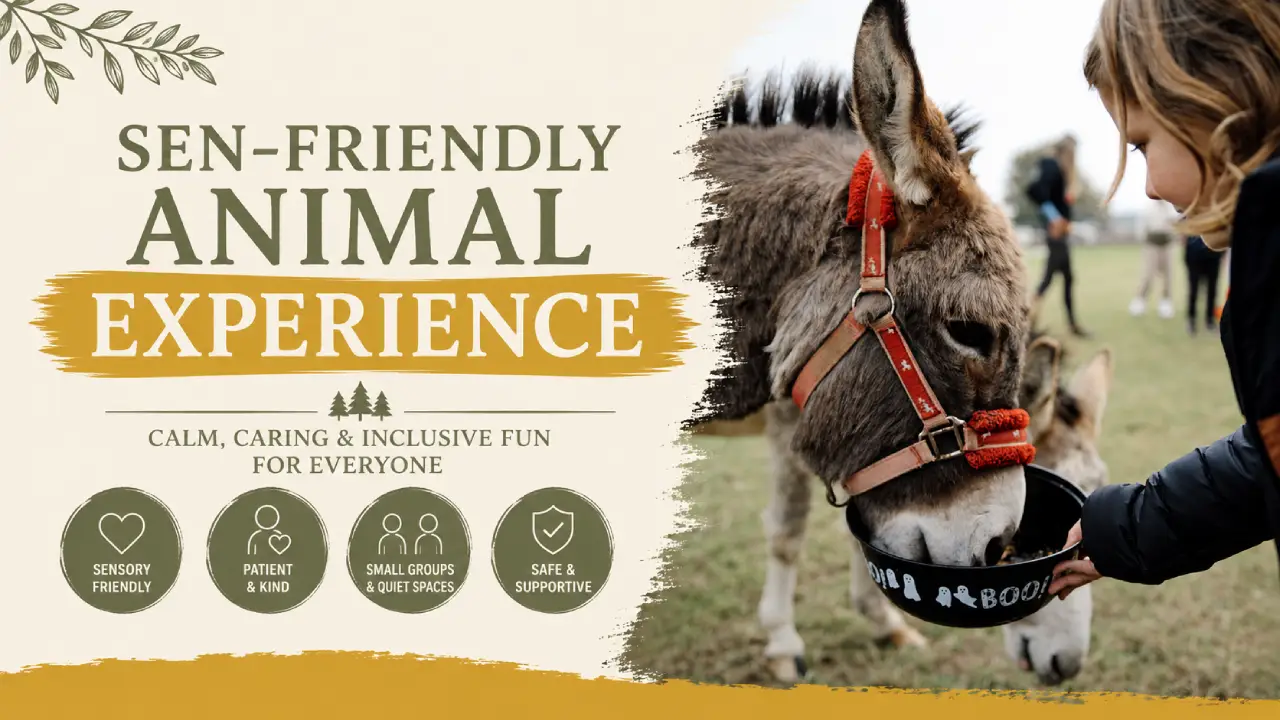
An SEN-friendly animal experience should make it easier for visitors to understand what will happen, take part at their own pace and step back when they need to.
That does not mean every sound, movement or moment can be controlled. Animals are unpredictable by nature. The aim is to remove unnecessary pressure around the experience and make the parts that can be planned as clear as possible.
At Meadow View Country Park near Wimborne, the guided daytime animal care experience is designed around small groups, a slower pace and a predictable structure. Visitors can meet the animals, observe their normal care and help with feeding where appropriate. There is no requirement to touch an animal or take part in every activity. Quiet observation is welcome.
For families and carers who find busy attractions difficult, knowing those details before leaving home can make a considerable difference.
What Makes an Animal Experience SEN-Friendly?
There is no single setup that works for every person with special educational needs.
Autistic people, people with ADHD and visitors with sensory sensitivities can experience the same environment very differently. The NHS notes that autistic people may respond differently to sounds, lights, smells, tastes and textures, and some people find changes to routine or unfamiliar environments particularly difficult.
A useful SEN-friendly experience therefore starts with flexibility rather than assumptions.
At an animal attraction, that can mean:
- A smaller group
- A clear beginning and end
- Simple explanations about what happens next
- Time to process instructions
- No pressure to touch animals
- Space to observe first
- An option to pause
- Staff who listen to parents, carers and visitors
- Advance information about likely sights, sounds and smells
The important point is choice. One child may want to feed a pony immediately. Another may be happier watching from further away for most of the visit. Neither response makes the experience less successful.
What Happens During a Visit at Meadow View?
Meadow View’s daytime experience is based around the everyday care of its animals rather than a performance or packed attraction timetable.
The visit is guided by Caroline, who owns, runs and looks after the animals. Visitors can meet ponies, donkeys and other animals, hear about them and see parts of their normal care routine.
Knowing roughly what the visit looks like can help families prepare.
Arriving and Settling In
The first few minutes should not need to be rushed.
A new place can involve several things to process at once: getting out of the car, seeing unfamiliar people, noticing animals, understanding the surroundings and hearing new sounds.
Parents or carers can tell Caroline beforehand if somebody normally needs a little longer to settle.
There is no benefit in forcing an immediate interaction simply because the session has started.
For some visitors, standing back and looking around is the first activity.
Meeting the Animals
Visitors are introduced to the animals rather than being expected to approach everything at once.
Ponies and donkeys are large animals. Someone who loves seeing horses in books may feel very differently when standing close to one for the first time.
It is fine to begin further away.
A visitor might watch somebody else stroke an animal before deciding whether they want to try. They may prefer to look rather than touch. They may approach one animal but not another.
The experience does not depend on completing a fixed checklist.
Feeding and Hands-On Activities
Feeding may be offered where it is appropriate for the visitor and the animal.
This can provide a clear activity with an obvious beginning and end. Caroline can explain what is being fed, how to offer it safely and what the animal is likely to do.
Some visitors may enjoy the repetition of feeding. Others may dislike the sensation of feed in their hand or an animal moving close to them.
Either reaction is acceptable.
Using a different method, watching somebody else or skipping the activity altogether can be better than turning a voluntary experience into a demand.
Watching Without Joining In
One of the most useful parts of Meadow View’s current approach is that observation counts as participation.
The park explicitly states that there is no pressure to join in and visitors are welcome to observe quietly.
That distinction matters.
A child does not have to stroke a donkey for the visit to have value. They might spend twenty minutes watching how it eats, moves its ears or reacts when someone approaches.
Visitors should be allowed to engage in the way that works for them.
What Might You See, Hear and Smell?
A calm animal experience is still an animal experience.
Parents and carers should prepare visitors for the natural parts of the setting rather than promise that it will be silent or completely predictable.
You may hear:
- Ponies or donkeys moving
- Animals eating
- Birds
- Other visitors talking
- Gates opening and closing
- Farm equipment
- Wind and rain
There will also be natural animal and outdoor smells.
Textures may include animal coats, feed, grass, mud and outdoor surfaces.
Some autistic people experience sensory information much more or less intensely than other people, and those differences vary widely between individuals.
If a particular sound, smell or texture is likely to be difficult, tell Meadow View before the visit. That is more useful than assuming the venue will automatically know what an individual needs.
Why Predictability Can Make a Visit Easier
Knowing what comes next can reduce one source of uncertainty.
The National Autistic Society advises that routines, advance preparation and visual prompts can be useful for people who prefer predictability. It also recommends allowing room in holiday and activity schedules for breaks rather than filling every part of the day.
For an animal visit, a simple sequence might be:
- Arrive at Meadow View.
- Meet Caroline.
- Look at the animals.
- Meet the ponies and donkeys.
- Watch or help with feeding.
- Spend a little more time with a preferred animal.
- Finish the session.
A family could write that sequence down before travelling or make a simple picture schedule for somebody who finds visual information easier to follow.
The schedule should still leave room for change.
How Parents and Carers Can Prepare Before the Visit
The most helpful preparation is usually specific.
Instead of saying, “We’re going to a farm tomorrow”, explain what you already know.
You might say that you are going to Meadow View near Wimborne, Caroline will meet you, there will be ponies and donkeys and you can look at them before deciding whether you want to get closer.
Photographs can help when available.
The National Autistic Society recommends showing pictures of new locations and preparing people in advance for unfamiliar situations where this is useful to them.
Parents and carers may also want to bring familiar items such as:
- Ear defenders
- A comfort item
- A preferred drink
- Suitable outdoor clothing
- A communication aid
- A visual schedule
These should be based on the individual’s normal needs rather than a generic SEN packing list.
What If the Plan Needs to Change?
Predictable does not mean rigid.
An animal may need rest. Weather can alter an outdoor activity. Feeding routines may change. A particular animal may not be available for close interaction that day.
It is better to tell visitors that changes can happen than promise an exact sequence that cannot always be delivered.
A useful approach is to explain the change simply:
“The pony needs to rest today, so we are going to see the donkeys first.”
Where possible, give the alternative immediately.
The National Autistic Society suggests preparing a plan B or plan C when changes may be difficult to manage.
Animal Welfare Comes Before the Activity
An inclusive experience still has to respect the animals.
Meadow View states that animal welfare comes first during its guided visits.
That means an animal should not be forced to remain in an interaction simply because a visitor expected to stroke or feed it.
This can also be a useful part of the experience.
Visitors can learn that animals communicate through movement and behaviour. Sometimes caring for an animal means giving it space.
A slower session makes it easier to notice those signals than an experience built around moving large numbers of people through as quickly as possible.
Who Might Prefer a Smaller Animal Experience?
A small guided session may appeal to families who find large farm parks difficult because of:
- Queues
- Crowds
- Loud play areas
- Frequent announcements
- Large numbers of activities
- Pressure to keep moving
- Unpredictable transitions
It may also suit someone who is particularly interested in animals and would rather spend longer observing a few of them than move between many attractions.
This does not mean a small setting is automatically suitable for every person with SEN or SEND. Dorset Council advises families to check individual activities and contact providers about the support available because needs vary between children and young people.
Questions to Ask Before Booking
Before arranging a visit, tell the venue what would genuinely help.
Useful questions include:
- How many people will be in the session?
- Who will meet us when we arrive?
- Which animals are likely to be involved?
- Does my child have to touch or feed them?
- Can we watch from further away?
- Can we pause if somebody becomes overwhelmed?
- What sounds should we expect?
- What is the ground like?
- What happens if an animal is unavailable?
- Can I explain communication or sensory needs beforehand?
It is equally useful to tell the guide what somebody enjoys.
A strong interest in ponies, feeding routines, animal names or grooming can provide a comfortable starting point for the visit.
Frequently Asked Questions
Are Animal Experiences Suitable for Autistic Children?
They can be, but suitability depends on the individual and the way the experience is run. Small groups, clear information and freedom to observe without joining every activity may help some autistic visitors.
Does My Child Have to Touch the Animals?
No. Meadow View states that visitors can observe quietly and there is no pressure to participate in every interaction.
Can We Explain Sensory Needs Before Visiting?
Yes. Contacting the park beforehand is sensible if particular sounds, textures, transitions or situations may be difficult.
What Animals Might We Meet?
Meadow View’s current guided experience includes ponies, donkeys and other animals cared for at the smallholding. Exact interactions can depend on the animals and their welfare needs on the day.
Is This Animal Therapy?
No. The guided animal care experience should be understood as an inclusive visitor activity rather than a medical, psychological or therapeutic treatment.
Planning an SEN-Friendly Animal Experience in Dorset
A good SEN-friendly visit is not measured by how many activities somebody completes.
For one visitor, the highlight may be feeding a pony. For another, it may be standing quietly and watching a donkey from a comfortable distance.
Meadow View Country Park in Wigbeth near Wimborne offers its guided animal care experience in small groups with a slower pace, predictable structure and no requirement to participate in every activity.
Before booking, talk to the park about what helps the person you are visiting with. Explain any important sensory or communication needs and ask what the session is likely to involve that day.
The aim is simple: fewer surprises, less pressure and enough time for each visitor to meet the animals in a way that feels manageable for them.